PowerNet Explorer™
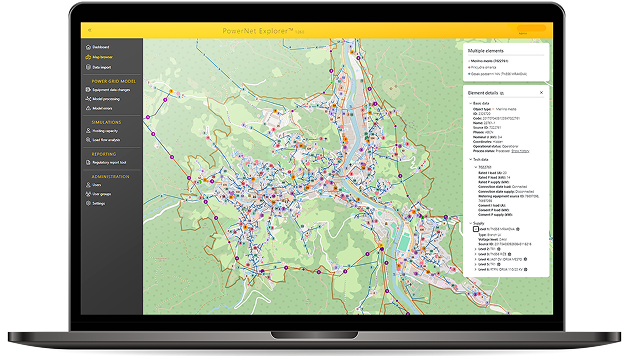
PowerNet Explorer™ is a state-of-the-art software solution designed to comprehensively process network topology and enable advanced energy analytics for electrical distribution grids. It provides all the essential building blocks to establish observability i.e., to monitor and understand the grid’s state in real time based on known topology and sufficient measurements as well as simulation capabilities to analyze the effects of connecting additional prosumers and exploring future grid development scenarios.
Centralized data hub
Integrates diverse data sources (GIS, ADMS, AMI, customer data, etc.) into a single platform with robust validation and transformation mechanisms to ensure data accuracy.
Accurate network topology
A verified logical and electrical connectivity model of all network elements enables the creation of a complete digital model of the 3-phase grid with chronological tracking of network topology changes.
Simulations and analyses
Support operational decision-making with advanced analytical tools.
Grid Topology
The Topology Processor serves as the backbone of PowerNet Explorer™, enabling the creation of a complete digital model of the 3-phase grid. It constructs a detailed network graph, building logical connections between elements based on geographic and measurement data.
Topology processor
Constructs a comprehensive network graph by building logical connections between elements based on geographic and measurement data.
Phase identification
Leverages AI algorithms to build a 3-phase network connectivity model using measurement and geographic data.
Error resolution
Topology processor identifies and resolves common issues such as poorly documented LV networks, incomplete links, overlapping lines, and parallel connections. Errors are categorized by severity, with the system offering automatic corrections or recommending field inspections when necessary.

Simulations and Analyses
PowerNet Explorer™ integrates advanced analytical tools to support operational decision-making and long-term planning.
Data Exchange and Reporting
The platform ensures seamless data integration for regulatory reporting,
compliance with Common Information Model (CIM) data exchange standards, and delivery of user-specific services (e.g., REST APIs).
Solution Architecture
PowerNet Explorer™ is built on a containerized, scalable architecture designed to seamlessly adapt to evolving demands.
Deployable in both cloud and on-premise environments, it offers unparalleled flexibility.
Key Benefits of Implementation